What SPF and farm pigs teach us about protective immunity against African swine fever
African swine fever virus (ASFV) causes a severe hemorrhagic disease in domestic pigs and wild boars, posing a significant threat to animal welfare and the economy in affected regions. The development of an effective vaccine is currently hindered by a limited understanding of the mechanisms involved in protective immune responses. Two recent publications from the Institute of Virology and Immunology (IVI) provide new insights linking the baseline immune status to the development of protection against ASF.
The SPF-IVI pigs: to study their immune response, the IVI has bred pigs for many years under exceptional experimental sanitary conditions characterised by the absence of swine pathogens. This special sanitary statute is associated with a particularly naïve immune system with a response to ASF virus infection that has enabled fundamental advances described in this project.
African swine fever virus (ASFV) is harmless to humans but causes a fatal hemorrhagic disease in domestic pigs and wild boars. In 2007, a highly virulent strain was accidently introduced in Georgia and has since spread to Europe and South-East Asia where millions of animals have died. Despite numerous efforts, the development of a safe and effective vaccine against ASF remains a major challenge and a high priority in the field.
So far, experimental vaccine candidates based on live-attenuated ASFV strains have shown promise in efficacy trials, but their safety remains a concern, in part because they may retain virulence in some context. In this line, previous studies have shown that pigs raised in commercial farms and those raised at the IVI’s specific pathogen-free (SPF) facilities differ in their basal immune status and particularly in their response to infection with a field-attenuated strain of ASFV with moderate virulence (Radulovic et al. 2022).
Building on these findings, we investigated whether variations in basal immune status due to different prior exposure to other pathogens would have an impact on adaptive immune responses against ASFV. First, we demonstrated that SPF pigs first exposed to a moderately virulent field strain were more resilient to a re-challenge with a highly virulent ASFV strain compared to farm-raised pigs (Radulovic 2025). In a follow-up long-term study, we performed a comprehensive analysis of innate and adaptive immune responses following immunization and re-challenge to define correlates of protection (CoPs) against ASFV infection (Lotonin 2025). Together, these findings bring us one step closer to understanding key immune responses associated with protective immunity against ASFV that will help the development of a safe and effective vaccine.
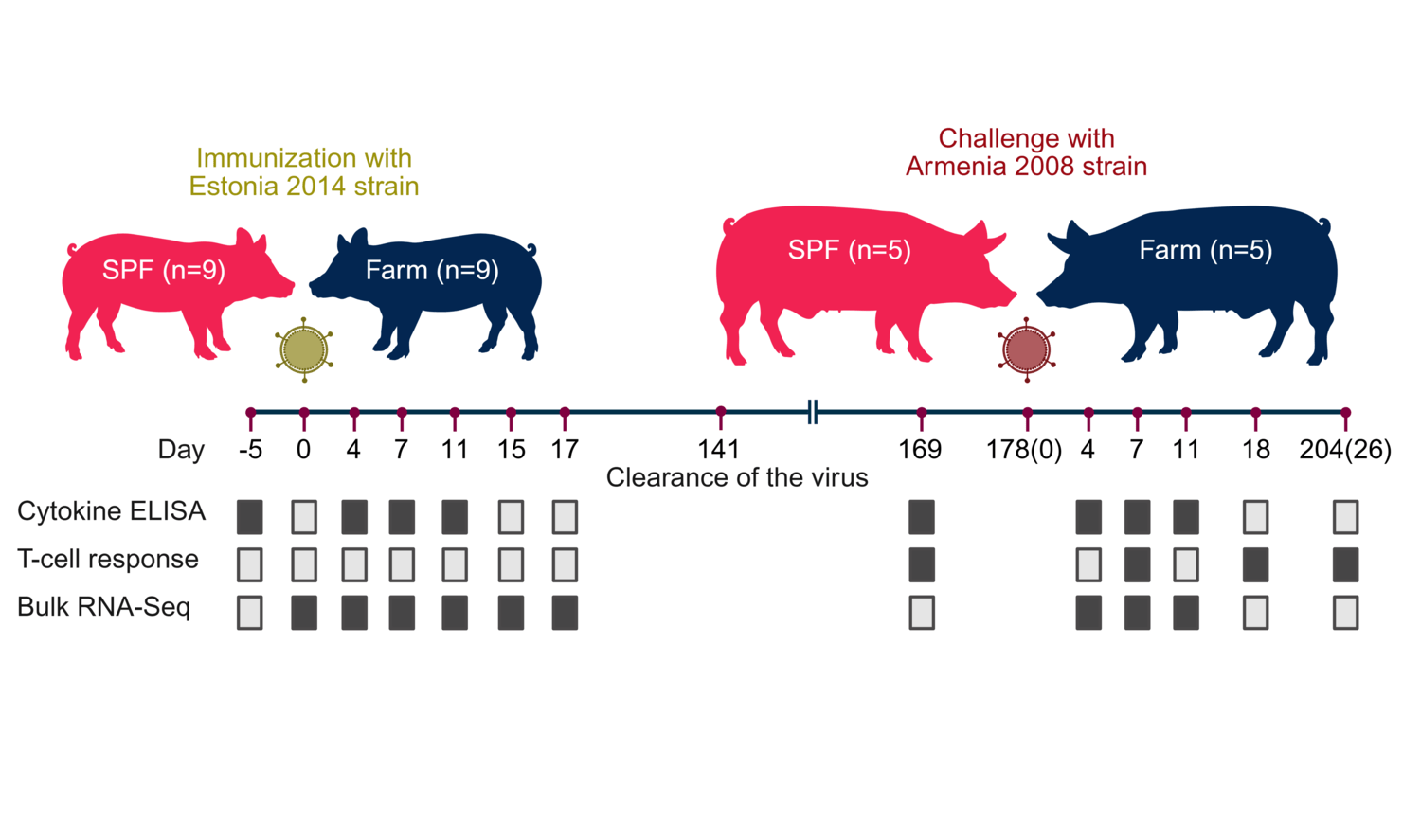
In both animal experiments, two groups of pigs were immunized with the attenuated Estonia 2014 ASFV strain. After the virus was cleared (approximately 5.5 months post-immunization), the pigs were challenged with the highly pathogenic Armenia 2008 strain. The first study focused on analyzing disease severity, systemic cytokine response, immune cell frequencies, and fecal microbiota composition. The second study included a more in-depth analysis of adaptive immune responses, specifically virus-specific T-cell activation and transcriptome changes in the blood of infected animals. The resulting datasets were correlated with clinical outcomes of the challenge to identify which immune responses were associated with protection and which with disease severity.
The study by Radulovic et al. (2025) demonstrated that baseline immunity associated with the hygienic status strongly influences the development of protective immunity against virulent ASFV infection. SPF pigs showed no clinical signs and were fully protected against the challenge, whereas farm pigs were only partially protected (40% of animals) and experienced a more severe disease course. Moreover, farm pigs exhibited a stronger pro-inflammatory cytokine response and more pronounced leukopenia following challenge. Significant differences in gut microbiota composition were also observed between the two groups.
The study by Lotonin et al. (2025) confirmed improved protection of immunized SPF pigs against re-challenge with the ASFV Armenia 2008 strain compared to pigs raised in a commercial farm. We showed that the induction of interferon-alpha (IFN-α) response, robust activation of memory T helper and cytotoxic T cells, as well as the upregulation of plasma cell transcriptome signatures, were characteristic features of protected animals against the virulent challenge. These identified CoPs were summarized in a model that highlights the critical role of host-specific factors in ASFV vaccine efficacy and provides a valuable framework for optimizing vaccine design.
The discovered CoPs against ASFV require further validation in a larger number of farm animals sourced from different genetic and environmental backgrounds. Furthermore, since the ASFV Estonia 2014 strain retains partial virulence, the analysis of innate and adaptive immune responses should be extended to different live attenuated vaccine (LAV) candidates, tested across various doses and administration routes. At the same time, identifying the immune components responsible for protection, such as plasma cell activation, opens avenues for further studies aimed at a more detailed analysis of the adaptive immune response to ASFV, for example through immune serum transfer experiments.
1.Emilia Radulovic, Kemal Mehinagic, Tsering Monika Wüthrich, Markus Hilty, Artur Summerfield, Nicolas Ruggli and Charaf Benarafa 2. Kirill Lotonin, Francisco Brito, Kemal Mehinagic, Obdulio García-Nicolás, Matthias Liniger, Noelle Donzé, Sylvie Python, Stephanie Talker, Tosca Ploegaert, Nicolas Ruggli, Charaf Benarafa, Artur Summerfield