
Coronaviruses cause respiratory and enteric viral infections and zoonoses
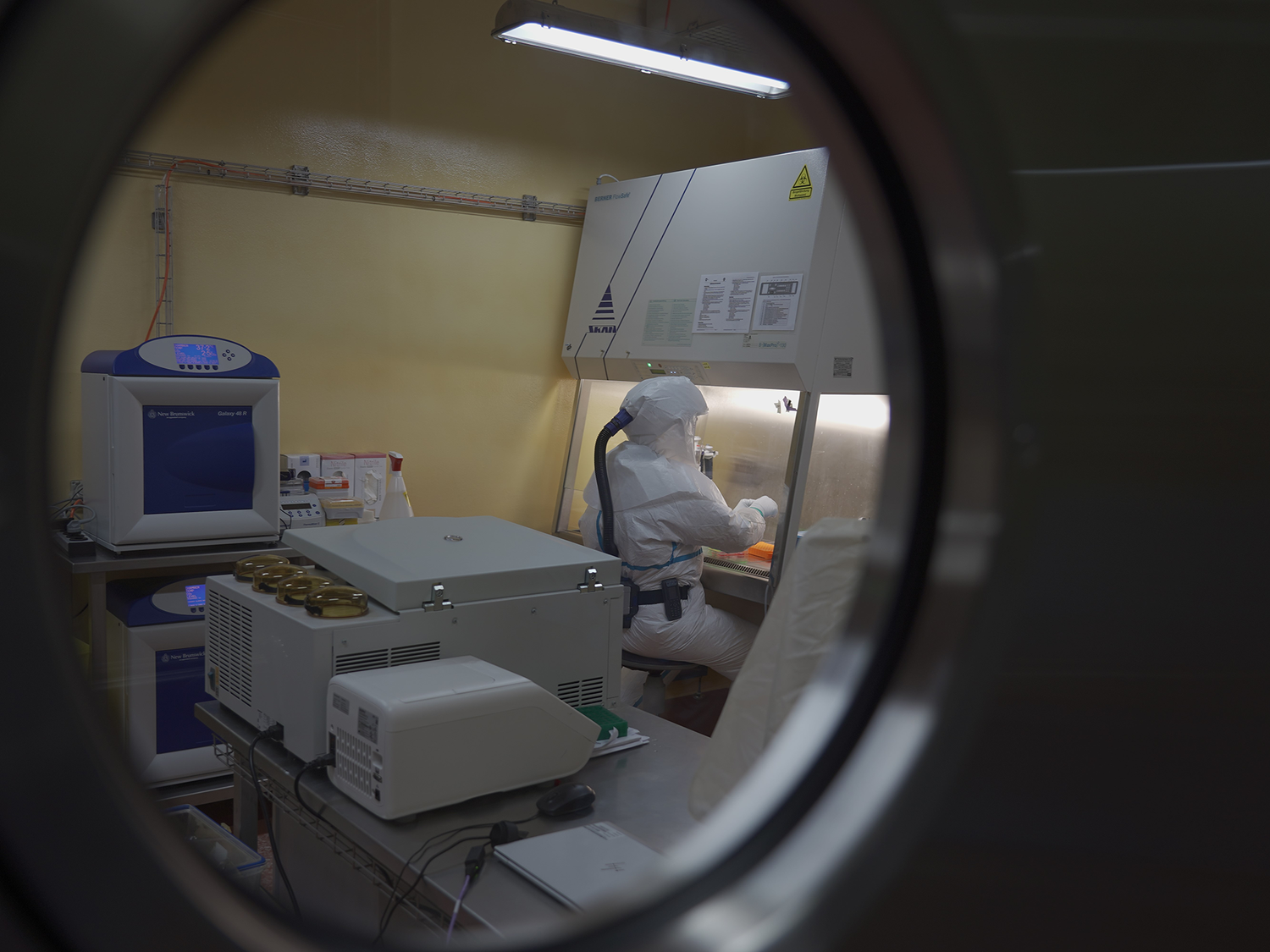
IVI coronavirus research is conducted in a biosafety level 3 laboratory. Researchers wear full-body protective suits that also cover the head. Virus work is carried out with extreme care using a biological safety cabinet.
Coronaviruses are RNA viruses that were first described almost a century ago. They are genetically very variable and capable of infecting many species of animal as well as humans. They therefore pose a high risk of causing zoonoses and reverse zoonoses (diseases transmitted from animals to humans and vice versa).
The best-known of these are the highly pathogenic coronaviruses that cause severe clinical symptoms in humans, such as SARS-CoV (Severe Acute Respiratory Syndrome Coronavirus), MERS-CoV (Middle East Respiratory Syndrome Coronavirus) and SARS-CoV-2 (Severe Acute Respiratory Syndrome Coronavirus 2). However, there are also many coronaviruses in veterinary medicine. These infect a variety of animals, including pigs, cattle, cats, dogs, rodents and birds. Coronaviruses in animals mainly infect the respiratory and intestinal tracts, causing not only respiratory symptoms, but also clinical symptoms such as diarrhoea, peritonitis, hepatitis and encephalomyelitis.
Examples of coronaviruses in animals:
Chickens: infectious bronchitis virus (IBV)
Cattle: bovine coronavirus (BCoV)
Cats: feline coronavirus (FCoV), feline infectious peritonitis virus (FIPV)
Pigs: porcine epidemic diarrhoea virus (PEDV), transmissible gastroenteritis virus (TGEV), porcine respiratory coronavirus (PRCoV)
News
A world network to monitor coronaviruses
CoViNet - CoronaVirus Network - is an international research network for the early detection, analysis and monitoring of coronaviruses worldwide. Set up by the World Health Organisation (WHO) and already operating in 20 countries, it now includes the Centre for Emerging Viral Diseases at the University of Geneva (UNIGE) and the Geneva University Hospitals (HUG), as well as the Swiss Federal Institute of Virology and Immunology (IVI), which is collaborating with the Vetsuisse Faculty of the University of Bern (UNIBE). This joint designation is part of a long-standing partnership between the WHO and these institutions. The members of the CoViNet met in Geneva on 26 and 27 March 2024 to define their strategic priorities and coordinate their actions.
Our activities at a glance
New vaccine candidate in the fight against new variants of SARS-CoV-2
Publikation in Nature Microbiology (Juli 2024) A safe, effective and adaptable live-attenuated SARS-CoV-2 vaccine to reduce disease and transmission using one-to-stop genome modifications«This candidate vaccine represents a significant advancement in our fight against emerging variants of SARS-CoV-2. Its safety profile and immune response make it a strong candidate for further clinical evaluation» says Tuba Barut postdoctoral researcher and one of the first authors at the IVI and University of Bern.The COVID 19 pandemic which has been responsible for around 7 million deaths worldwide, necessitates continuous innovation in vaccine development. While existing COVID-19 vaccines have been successful, the need for improved more efficient vaccines remains critical to combat emerging variants and most importantly curb transmission which is not possible with existing vaccines.A collaborative effort between the IVI and the Friedrich-Loeffler-Institut FLI Germany, has yielded a breakthrough. Researchers, working with the support of Swiss start-up company RocketVax, have developed a live vaccine candidate:
An RNA replicon system to investigate promising inhibitors of feline coronavirus | Journal of Virology (asm.org)
An RNA replicon system to investigate promising inhibitors of feline coronavirus | Journal of Virology (asm.org)«Feline infectious peritonitis (FIP) is a fatal feline disease, caused by a feline coronavirus (FCoV). FIP is of great significance in the cat population, being a major cause of feline deaths in veterinary practices. As there are no approved treatment options available, there is an urgent need to identify antiviral drugs against FIPV. A baby hamster kidney 21 cell line expressing a serotype I Feline Coronavirus replicon RNA with a green fluorescent protein reporter gene was produced and used as an in vitro screening system to test different antiviral compounds. Multiple effective candidates were found and the successful implementation of this system for antiviral screening was demonstrated. It can be expected that this system will facilitate future screens for anti-FCoV compounds and provide a non-infectious system to study and evaluate drug resistance mutations that may emerge in the FCoV genome.»
Neu entdeckte Eigenschaften von Omikron tragen zu dessen Bekämpfung bei
Omikron weist einen Evolutionssprung im Vergleich zu den vorherigen Virus-Varianten auf: Es vermehrt sich mehr in der Nase und weniger in den Bronchien. Dies zeigt eine vom Institut für Virologie und Immunologie (IVI) und der Universität Bern in Zusammenarbeit mit dem deutschen Friedrich-Loeffler-Institut (FLI) durchgeführte Studie. Die neuen Erkenntnisse tragen zu einem besseren Verständnis des Virus bei und ermöglichen Fortschritte bei der Entwicklung wirksamerer Impfstoffe.
RocketVax AG gibt neue Meilensteine in der Entwicklung von COVID-19-Impfstoffen der zweiten Generation bekannt
Weil das SARS-CoV-2-Virus bleiben und weiter mutieren wird, muss die Forschung und Entwicklung von wirkungsvollen Impfstoffen mit hoher Priorität weitergeführt werden. Die Forschungsgruppe von Prof. Volker Thiel am IVI und an der Universität Bern entwickelt Impfstoffe mit einem abgeschwächten SARS-CoV-2 Virus.Medienmitteilung RocketVax AG
Improved COVID-19 vector vaccine candidate
In response to the SARS-CoV-2 pandemic, numerous research projects have been launched to develop vaccines against this emerging pathogen. In a recent publication in the Nature portfolio journal «npj vaccines», scientists at the Institute of Virology and Immunology (IVI) and the University of Bern report on a Vesicular Stomatitis Virus (VSV)-vectored COVID-19 vaccine candidate. Their work shows that intramuscular immunization of mice with VSV-vectored COVID-19 vaccines is inducing strong antibody responses against the SARS-CoV-2 spike protein only if the vector has been complemented with the VSV glycoprotein G.LINK media release
Findings on a Coronavirus in pigs help us to understand the SARS-Coronavirus-2
A research programme supported by the FSVO on preventative measures against outbreaks of coronaviruses in the veterinary field delivered significant findings on viruses that jump from animals to humans. Thanks to these findings the emerging zoonotic viruses, such as SARS-Coronavirus-2, can be better investigated.