

African swine fever: Complex virus leaves many questions unanswered
African swine fever (ASF) is a major viral disease that affects both domestic and wild pigs. The ASF virus was first detected in Africa, from where it has spread worldwide, causing significant economic losses in the pig sector. In Africa the virus is transmitted by soft-bodied ticks, primarily between African wild pig species such as warthogs, bushpigs and brush-eared pigs. However, these species do not usually become infected. In contrast, ASF infection of domestic pigs or Eurasian wild pigs leads to serious disease, often accompanied by high mortality. Transmission between domestic pigs and Eurasian wild pigs mainly occurs through direct animal-to-animal contact or through contaminated products. There are currently no registered vaccines or treatment options. ASF poses a threat not only to the pig sector, but also to wild pig populations.
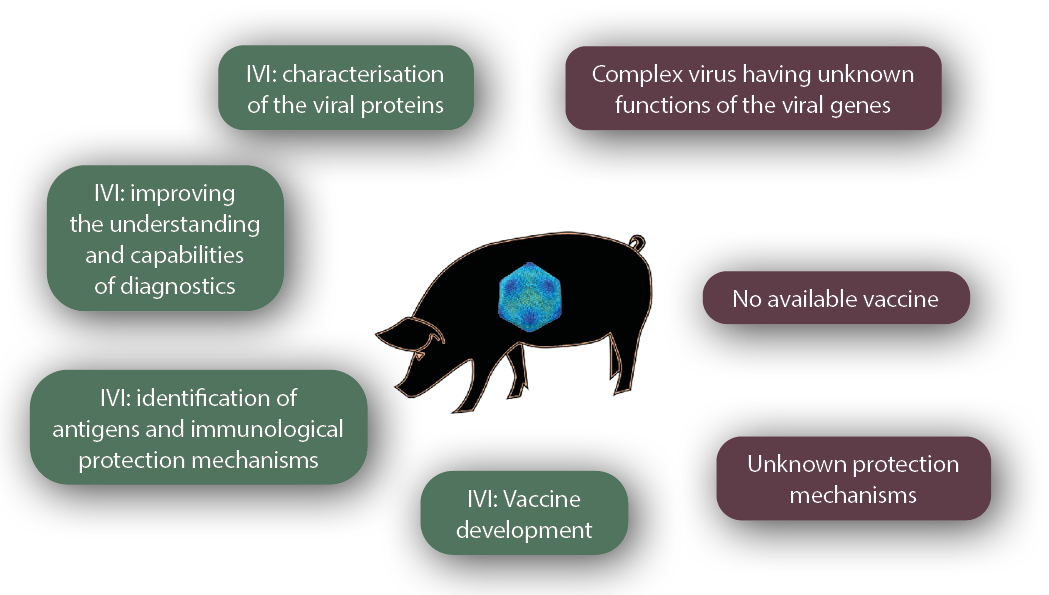
Our activities at a glance

Blog Kirill Lotonin – African swine fever
“A comprehensive analysis of both protective and detrimental immune responses to ASFV is essential for the development of a safe and effective vaccine. “
What SPF and farm pigs teach us about protective immunity against African swine fever
The SPF-IVI pigs: to study their immune response, the IVI has bred pigs for many years under exceptional experimental sanitary conditions characterised by the absence of swine pathogens. This special sanitary statute is associated with a particularly naïve immune system with a response to ASF virus infection that has enabled fundamental advances described in this project.

Blog Kemal Mehinagic – African swine fever
«The ASF virus fascinates me and I know it still holds many secrets I’d love to unravel».

Blog Emilia Radulovic – African swine Fever
«The results of my thesis on African swine fever are of major importance for the future development of live attenuated vaccines».
African swine fever : Clinical symptoms in pigs - how and when to react?
Although Switzerland is not presently afflicted by the African swine fever (ASF), the Institute for Virology and Immunology (IVI) is nevertheless working to determine the properties of the ASF strains that are circulating in Europe. Were there an outbreak in Switzerland, it would be important to ensure efficient and reliable laboratory diagnostics and to be continually abreast of the newest research findings in order to be able to deliver critical virological, immunological, clinical and pathological information to the Swiss veterinary service (in German).
A highly sensitive system for detection of ASFV infection in cell culture
The method of choice for the detection of ASFV is PCR. However, PCR provides no information on whether the sample contains live virus or on virus infectivity. The latter is determined by a complex process of virus isolation and titration. To simplify and automate this process, we have established a novel method for the detection of infectious ASFV.
This research has been published in the journal Viruses.
Different factors affect progression of the disease
The hygienic status of pigs plays an important role in disease severity during infection with an attenuated strain of the African swine fever (ASF) virus). Studying surviving animals will contribute to the eventual development of a vaccine. Recent research conducted at the IVI in collaboration with the University of Bern have just been published in the journal PLOS Pathogens.
African swine fever : the hygienic status of pigs plays an important role in the development of the disease
What are the most important results of your study? How will these results eventually contribute to development of a vaccine? Listen to the answers of Kemal Mehinagic.
A molecular platform for ASFV genome manipulation in yeast
A molecular platform for ASFV genome manipulation in yeast
Aiming to establish a molecular platform for ASFV genome manipulation, we have reconstructed the entire genome of a highly pathogenic ASFV isolate in yeast. This method has been published in the journal STAR Protocols.
More information
Federal Food safety and Veterinary FSVO
Friedrich-Löffler-Institut FLI: