
Rabies testing in humans

In rabies vaccination, a distinction is drawn between preventive vaccination before any contact with the virus (pre-exposure prophylaxis) and the more complicated vaccination after possible contact (post-exposure prophylaxis) (FOPH guidelines and recommendations: pre- and post-exposure rabies prophylaxis in humans, German).
Pre-exposure prophylaxis (PrEP)
Please note that special requirements apply to people suffering from immunosuppression (german or french).
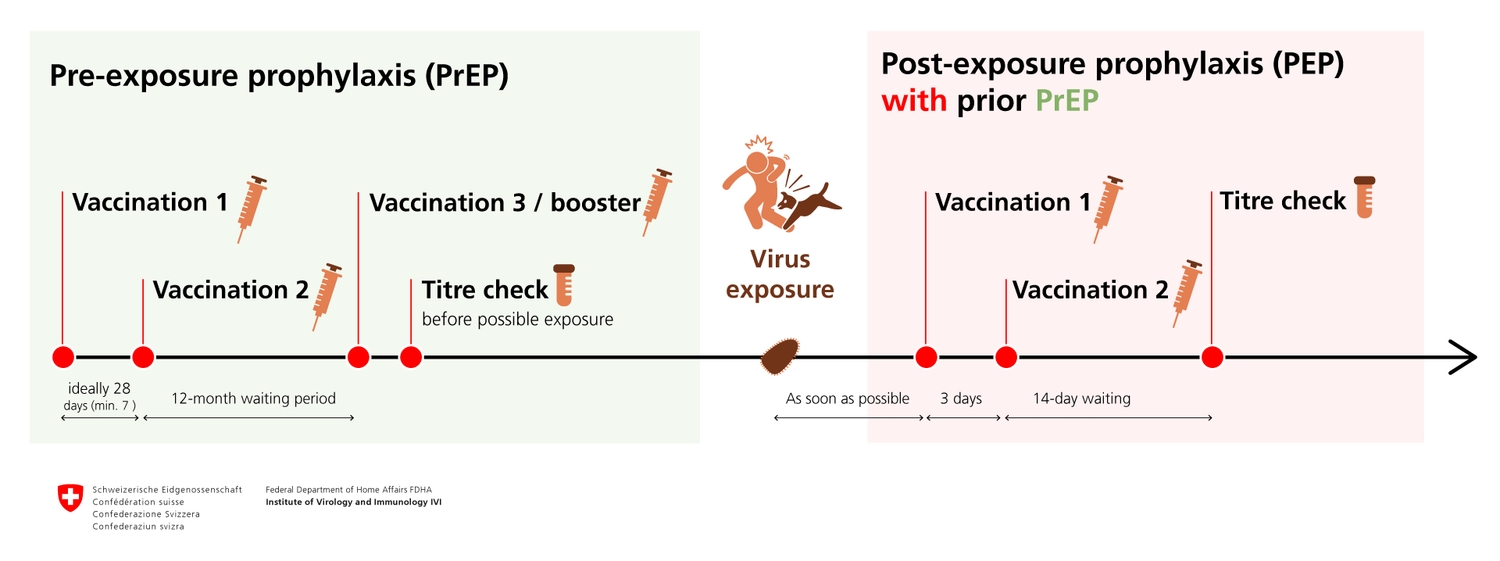
PrEP is recommended for people likely to come into contact with rabies virus in the course of their work (such as veterinarians, veterinary students, veterinary practice staff or animal keepers) or for people travelling to rabies risk countries, especially if they have contact with animals there. Post-exposure prophylaxis (PEP) is shorter and less complicated for people who have had prior PrEP. Pre-travel vaccination is also recommended because vaccines and immunoglobulins (antibodies) are not always available in many destination countries.
Diagram of pre-exposure prophylaxis (PrEP) and PEP according to FOPH guidelines (adults and children without immunosuppression):
Post-exposure prophylaxis (PEP)
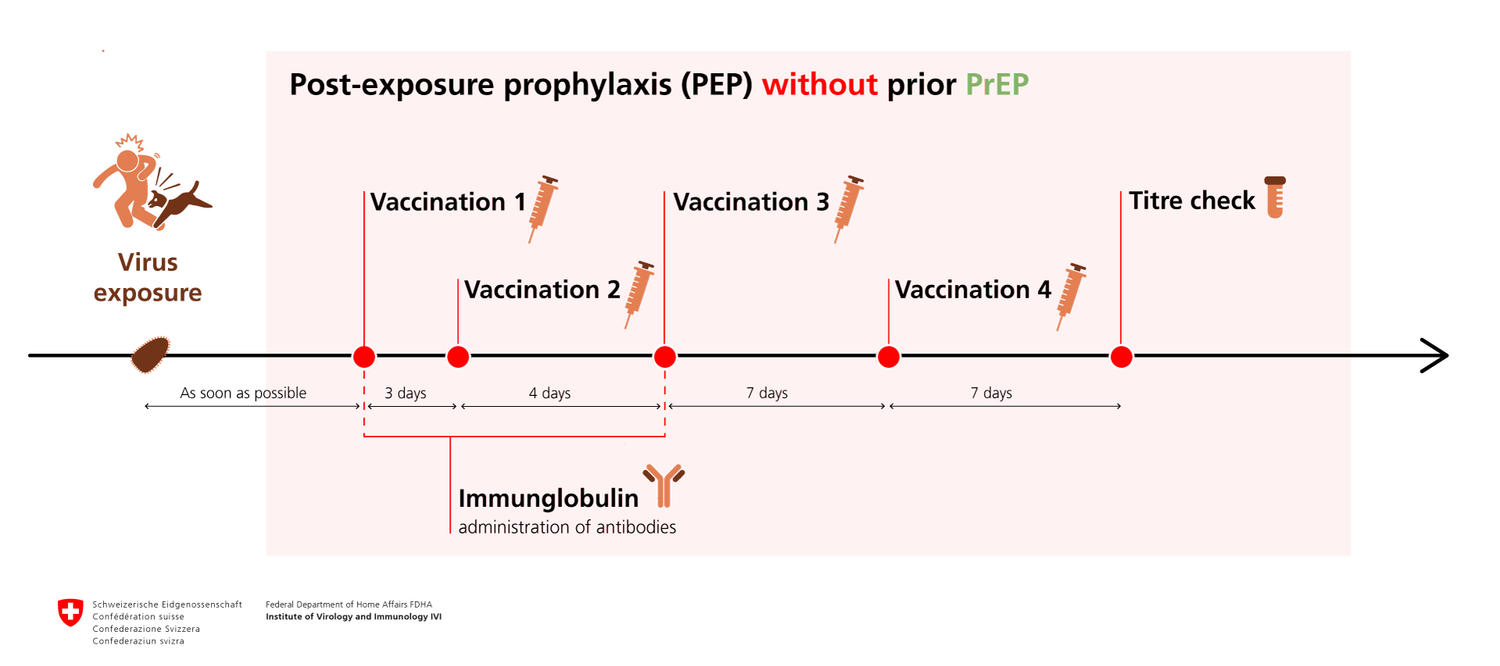
A combination of vaccination and administration of antibodies (immunoglobulins) is used to prevent rabies viruses that have been transmitted to a human, e.g. by a dog bite, from reaching the nerve pathways. Once viruses are in the nerve cells, nothing more can be done to combat them, which is why PEP should be started as soon as possible after a chance of infection.
In most cases, rabies is transmitted to humans by bites and scratches from infected animals or by contact between their saliva and human mucous membranes (e.g. in the eye, nose or mouth). Whether PEP is indicated can be assessed by means of a risk evaluation (Pre- and post-exposure prophylaxis for human rabies, see chapter 6 > fig 1, p 13), German).
Immediate steps after contact with a potentially rabid animal
Wash out injuries with soap and water for 15 minutes and disinfect if possible. Then consult a medical facility immediately to clarify whether to initiate PEP. This is necessary even for people who have already been vaccinated against rabies.
Serological checks
A serological check is recommended after all PEP and in special situations also after PrEP. An antibody level of ≥0.5 IU/ml (in the rapid fluorescent focus inhibition test (RFFIT)) is the WHO-defined correlate for post-vaccination protection. If the antibody level is not high enough, further vaccination doses are recommended until the figure of 0.5 IU/ml is reached.
Diagram of post-exposure prophylaxis (PEP) according to FOPH guidelines :
Information for doctors on sample submission and testing
Rabies antibody titre determination
Opening hours and availability
We aim to adhere to the stated testing times wherever possible. However, as the number of samples currently exceeds our testing capacity, it is not always possible to process them all immediately. Thank you for your understanding!
Request for analysis
In detail
Swiss Rabies Centre
Swiss Rabies Centre (Monday to Friday)
Länggassstrasse 122
3001 Bern